The North Sea body discovery
The Woman in Cabin 10The North Sea body discovery is the recovery of a woman’s body by Danish fishermen in the North Sea off Norway, first reported as a possible answer to Laura Blacklock’s disappearance. Its significance changes as the investigation develops: the first body is identified as Anne Bullmer, a second is recovered and identified as Richard Bullmer, and early reports about Laura’s fate prove misleading. The sequence exposes how uncertain jurisdiction and imperfect communication can shape a case before its central facts are known.
The First Recovery and the Missing Journalist
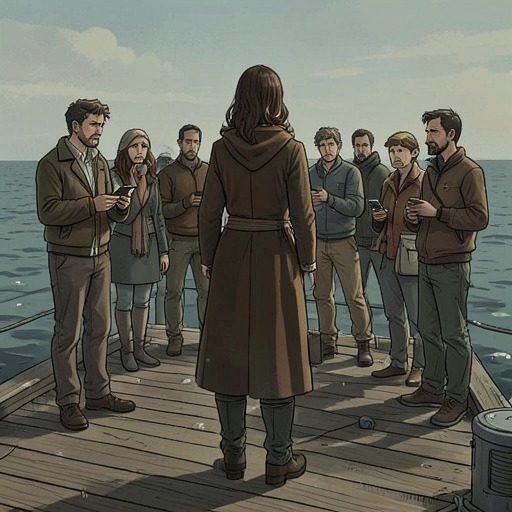
The first public account appeared on the BBC News website on Monday, 28 September. It reported that Danish fishermen had dredged a woman’s body from the North Sea in the early hours of that morning. Because Laura Blacklock, a 32-year-old British journalist, had disappeared while holidaying in Norway the previous week, the report said the discovery lent weight to speculation that the body might be hers. The woman’s identity had not yet been confirmed.
The report also announced that Scotland Yard had been called in to assist the investigation in Norway. A Scotland Yard spokesperson declined to comment on any possible connection between the body and Laura’s disappearance, while the police in Norway said that identification was still under way. These qualifications sat beside the speculation in the same report: the possibility that Laura had been found was prominent, but it was not a confirmed identification.
Laura’s partner, Judah Lewis, refused to engage with the speculation when contacted at his home in North London. He said he was devastated by her continued disappearance. His response keeps the human consequence of the report in view without confirming what the recovered body was or what had happened to Laura.
The Maritime Jurisdiction Problem
The discovery takes place against the uncertainty surrounding crimes committed at sea. Laura knows that cruise-ship investigations can fall into a legal grey area: in international waters, a vessel’s onboard security may be left to handle a disappearance, even though its personnel are employed by the cruise company. That structure can leave an investigation without an obvious independent authority to take charge.
When Laura asks Richard Bullmer whether the ship can reach a port where she can report the incident, he says the Norwegian police might be unable to act if it occurred in British or international waters. He adds that the vessel is registered in the Cayman Islands and that he must ask the captain how this affects the situation. The exchange does not establish which authority ultimately has jurisdiction over the events aboard the ship; instead, it shows how the uncertainty delays a clear route to investigation.
The ship’s movement sharpens that uncertainty. It leaves Hull Harbour and enters the North Sea, and Laura later learns that it is in international waters and bound for Trondheim. While offshore, she sees a vast stretch of sea with no land or ship in sight and recognizes that she has no way to call for help. The later recovery of bodies in the North Sea turns that isolation into part of the investigative setting: the water is both the place where evidence is found and the distance separating the events from straightforward intervention.
Two Bodies and a Revised Account
The first recovery is not the only one. When Laura is eventually told the results of the search, an embassy official says that the police have found two bodies: the first dredged up by a fishing boat in the early hours of Monday, and the second recovered later that day by police divers. The second body is identified in subsequent reporting as Richard Bullmer, found several hundred miles away near Bergen after he was reported missing from his boat, the Aurora.
On 26 November, a newspaper report identifies the woman’s body as Anne Bullmer, Richard’s wife and heiress to the Lyngstad fortune. Norwegian police state that Anne died by drowning. The identification overturns the first report’s central public suspicion: the woman recovered by the fishermen was not Laura, who is later found alive in Norway.
The same report revises the account of Richard’s death. His body had suffered a gunshot wound to the temple, but the local pathologist’s findings establish that the injury was not self-inflicted, contradicting earlier reports of suicide. A gun recovered alongside his body was wrapped in clothing belonging to Laura, which prompted initial allegations connecting Richard’s death to her disappearance. The report says that police interviewed Laura but were not treating her as a suspect in either death, and that the investigation remained ongoing.
Misidentification, Reporting, and Consequence
The public confusion has consequences beyond the investigation. Laura’s parents are left for several days believing that the body may have been identified as their daughter’s. Scotland Yard stresses that the body was never formally identified as Laura, but acknowledges that information about her clothing being found with Richard’s body was poorly communicated to her family, citing communication problems between forces. The distinction between a mistaken identification and a failure to communicate is important: the report does not say the first body was officially declared to be Laura, but it shows how speculation and poorly conveyed information could make that fear feel confirmed.
The two recoveries therefore create a sequence of reversals rather than a single answer. The first body appears to close Laura’s disappearance, then becomes Anne’s; the second establishes Richard’s death, but also unsettles the apparent suicide explanation and links Laura to the physical evidence without making her a suspect. By the time Laura is found alive, the bodies have already generated public claims, family distress, and competing accounts that the authorities must disentangle.